The past couple of months for Tiffany and I have been a combination of exploring Ensenada, relaxing, traveling to visit family, and managing a few more major projects on Luna Moth. Yes we actually rolled the dice and hired workers, but that’s a topic for another post. This post is how we revamped our electronics on Luna Moth, something we’ve talked about at various times, but about which I continue to get questions. It’s going to get long and be technical, but I’ll try to explain things in such a way that it’s understandable without a degree in Computer Engineering.
The Motivation, A Story, and a Quick Rant
If you’ve been around us in an environment where alcohol has been involved, you’ve probably heard me (Lisa) rant about how anti-consumer the marine electronics industry is. If not, the following anecdote might give you some idea:
While we were at Ballena Bay, a nice couple had a new to them trawler in the slip next to us which they had bought with the intention of coastal cruising. She was a lovely boat and in great condition, despite being not at all new. The couple had seen a shiny new chartplotter at a boat show and had decided to upgrade before they shipped their boat east to do the Great Loop (Great Lakes->Mississippi->Gulf->Keys->intercoastal waterway->Saint Lawrence River, etc). Still working and not technical, they hired an installer who over the course of about a month set off a chain of “required upgrades” to go along with the shiny new chartplotter. They slowly found out that every piece of electronics, every display, every sensor, the VHF radio, even the stereo, would need to be upgraded to be compatible with the new chartplotter. Of course this would not only require upgrading communication cabling, but also power cables and breakers. By the time they were done $60,000 had changed hands. To pay for it they postponed retirement another year. In that time health events happened and they ended up selling the boat, having never gotten to go on their adventure.
Consumers should have a better option. There is no reason for a new chartplotter to force the upgrade of a sensor. Gear from one vendor should interoperate with another. As a fun side project, I decided to make a demo system on Luna Moth showing that things didn’t have to be like this and highlighting what can be done with simple, open source solutions.
The Starting Point
Luna Moth came with aging chartplotters, one in the cockpit and one at the navigation station, both dating back to 2006. These power hungry beasts were on their last legs and had the processing power of a computer from the late nineties While those needed to go, the various instrument displays we had around the boat were great, the radar worked fine, as did the depth, water temperature, and speed sensors. We had a very good AIS transmitter (a radio device that lets surrounding boats know we are and which way we’re going), though it was isolated and not connected to the chartplotters.
Our radio had wasn’t capable of ship to ship calling (DSC) and shared an antenna with an AIS receiver via a less than trustworthy antenna splitter setup. That had to go. The chartplotters had to go. We wanted DSC. Weather, time, and probably birds, had taken out our wind sensor so that needed to be replaced, but that was a relatively straight forward task. The electronics on our autopilot were good, so we left that, only fixing how it was wired as someone along the way had swapped the primary and the secondary inputs.
The GPS that was hooked up to the chartplotters thought it was in the 1990s and didn’t know the day of the week (Google GPS epoch if you want to go down the rabbit hole of how time is determined by GPS devices (or don’t and enjoy a good walk instead as that is several hours I’ll never get back)). While on the surface this didn’t seem like a big deal, we didn’t want to trust what DSC would do with incorrect information.
The Plan
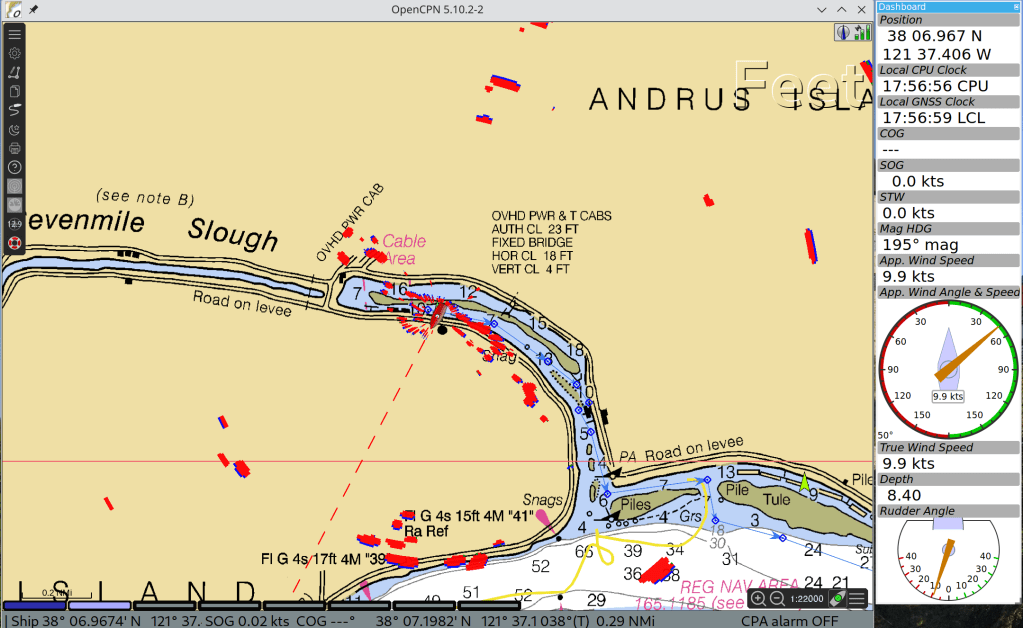
Over the next few tech blogs I’ll go into more detail on the solution we settled on, but the overall plan was to rip out the chartplotters and replace them with rugged tablets and laptops that connect to the various sensors via a self designed bridge implement using a low power, system on a chip, microcontroller. For the less technical readers who made it this far, imagine a tiny chip that does all the interesting things that a computer does without some of the more complex things, and without the electronics that drive a display, all while consuming a tiny fraction of the energy used by a real computer. The bridge would not only get things like depth and wind speed to the tablets, but also GPS position and AIS information about nearby ships to the tablets, phones, etcs. It would have an audible alarm so that if a ship was going to get close, the crew would be alerted without the need for a chartplotter.
Additionally the radio would be upgraded for one that does DSC and had AIS receiving and the existing splitter would be removed. We’d keep the existing transponder and its separate, stern mounted antenna, giving redundancy with AIS receiving, something we feel is important. Since the radio antenna was mounted on the mast and would have farther reach, it would be used as the primary source of AIS information. When DSC calls are made, one of the things that’s transmitted is position information obtained from GPS. While the radio we chose, a Standard Horizon GX2400, has an internal GPS, it’s mounted inside the hull and not as accurate as a dedicated outdoor antenna. We solved this problem by bridging the GPS messages from the AIS transponder unit via the instrument bridge.
A nice byproduct of moving away from marine industry chartplotters is a reduction in power usage while underway. Instead of running with our old power guzzling cockpit and navigation station chartplotters running 24/7, we can run with the low power bridge on and a single, low power tablet who’s screen need not be on when not being looked at.
In the next post I’ll do a quick overview of our instrument bridge and talk about the lessons we learned from it.

 SV Luna Moth
Leave a comment