Today Lisa takes over the Luna Moth blog for her first Tech Corner post. While our blog is generally going to be about life on board, often touching on aspects unique to blind sailing, this series will be a lot more technical in nature, with deep dives into the details of various boat systems and projects. It assumes a strong knowledge of boat mechanics and might not be everyone’s cup of tea. With the disclaimer out of the way, let’s dive in…
Most cruising boats have a two battery bank system with a house bank which is used for things like lights, refrigeration, instruments, etc and an engine starter battery bank which is used for starting the engine (and possibly a generator). The reason for the separation is two fold, one so that different battery designs can be used for each and, somewhat more importantly, the engine battery can be kept in reserve so that it’s always ready to go to help motor you out of trouble, even if a guest tries to run their hairdrier on the inverter.
There’s a couple of different approaches that designers use for charging both batteries, one typically found on day cruisers, uses multiple output shore chargers and alternators, and the other using battery combiners. Both are problematic, but since Luna Moth came with a battery combiner, I’ll focus on these though the problems I’ll mention are common to both designs.
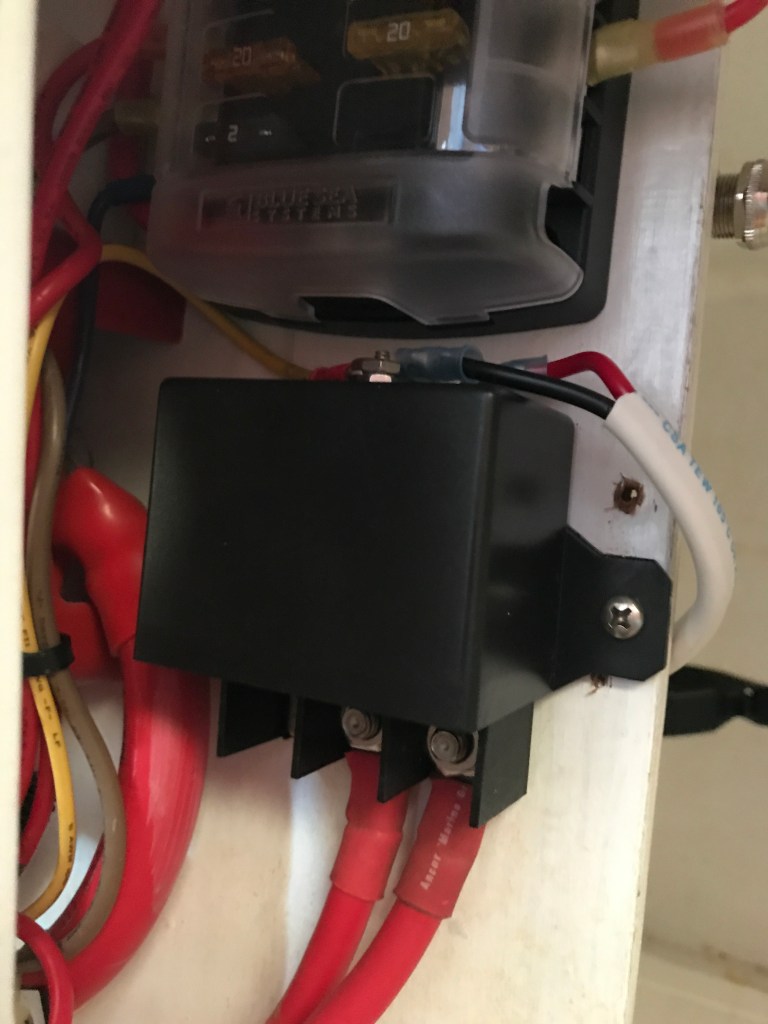
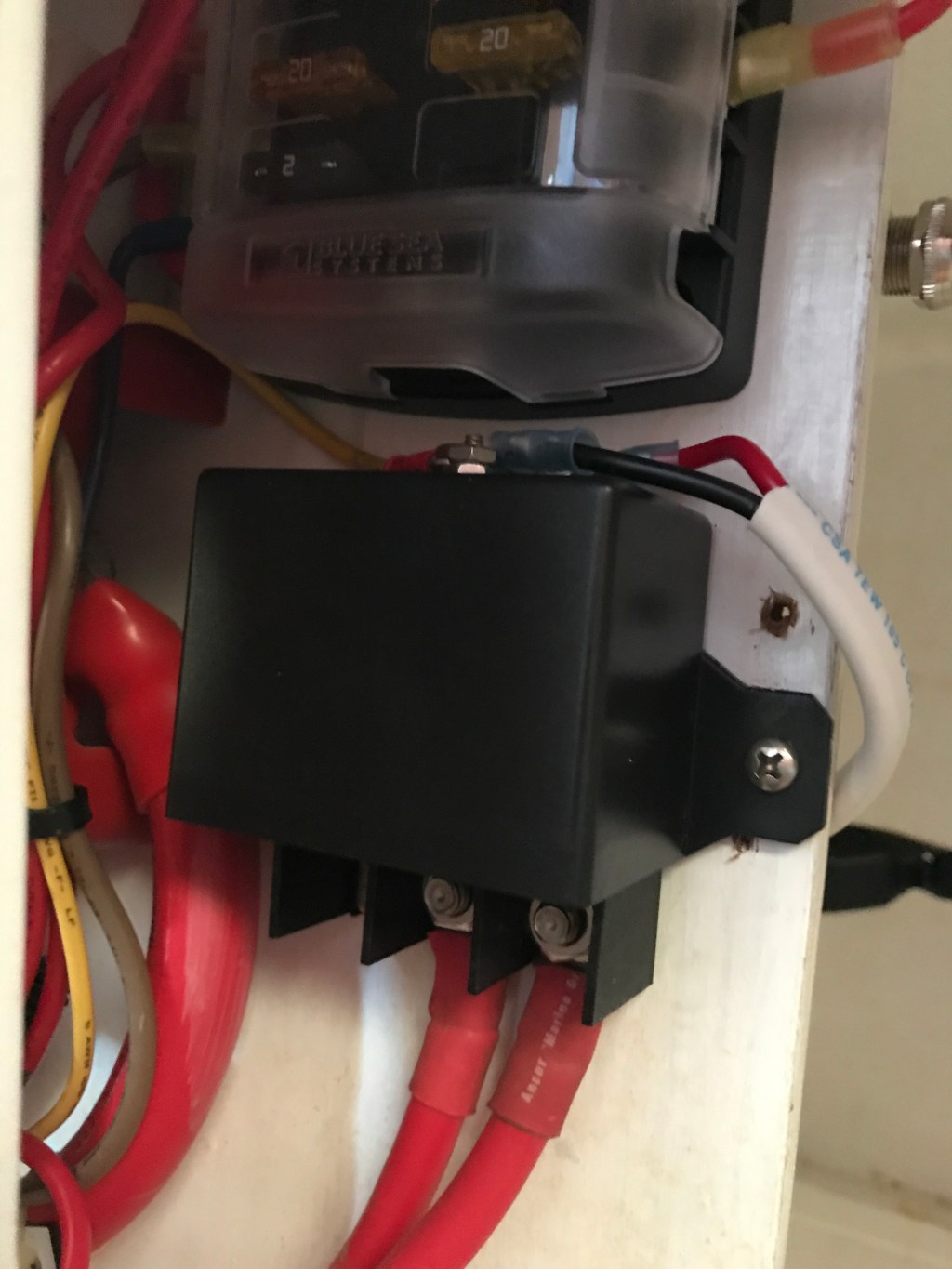
A battery combiner is pretty simple electrically and can be thought of as a relay which shorts two battery banks together if the voltage on the source battery bank is above a preset charging voltage. On a cruising sailboat all the charging sources such as solar, wind, engine alternator, and generator could charge the house bank and the combiner would tie the two banks together whenever things were being charged and break them apart when they weren’t. The engine battery would go along for the ride when solar kicked in in the morning, but would be isolated as the house bank was depleted, making sure it has the energy required to start the engine. Cool right?
Not so fast…
There are two problems with this, the first being that different battery technologies want to be charged at different voltages. This means that if you have an AGM house bank and a flood lead acid starter battery, your starter battery is going to be charged on AGM curves. Not the best for the life of your battery.
The second, much bigger problem, is the difference in how energy is depleted from the two banks. While the engine bank on a sailboat might deliver a high current to start the motor, it’s for a very short period of time and the battery itself is not discharged to a very noticeable amount. This is very different from the house battery bank which could be drawn down considerably between periods of solar power production or runs of a generator. As a charge cycle starts (aka the sun comes out on a predominately solar powered boat), the charging starts on the house bank and as its voltage starts to rise, the batteries are combined. While the engine battery might need topping off, and could benefit from a float current, it’s instead subjected to a potentially all day charge cycle with a long time at voltage not appropriate for its state of charge. This leads to overcharging, off gassing, and reduced battery life (aka battery murder).
Typically boat manufacturers put in a cheap flooded lead acid battery and shrug off the battery abuse as being mitigated by the low replacement cost. In my opinion this is environmentally inappropriate. It also pushes you to use flooded lead acid batteries which can spill acid when a boat heels past ~45°. While we sail pretty conservatively on Luna Moth, knockdowns are in the set of Bad Events that we want to be prepared for and neither of us fancies worrying about cleaning up acid when we should be reducing sail. Because of this we opted for an AGM starter battery which is sealed, and designed to be installed in any orientation with the acception inverted. These are not, by our standards anyway, cheap and treating them as disposable was a non-starter.
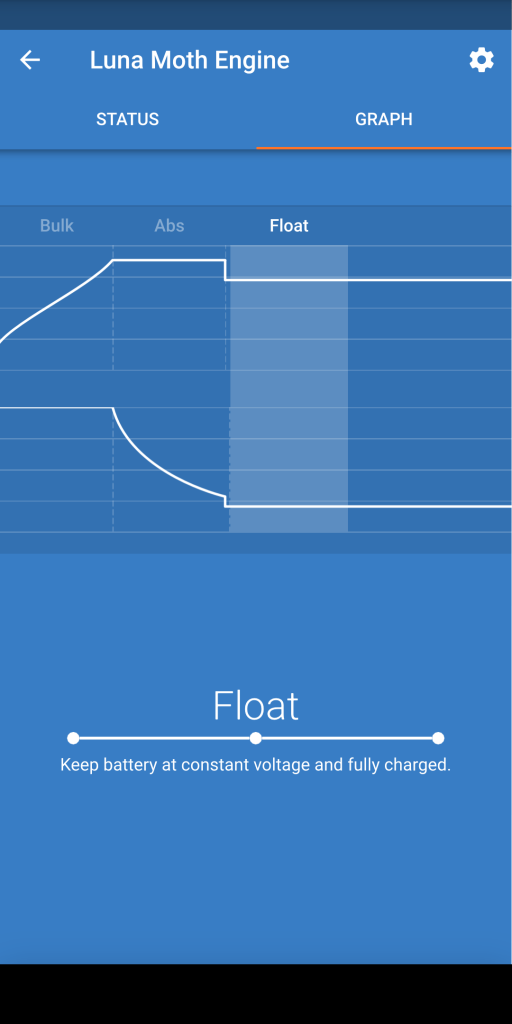
Our solution to protect the life of the new battery was to rip out the boat’s battery combiner and install a Victron Orion DC-to-DC charger. While battery combiners are rather simple, the Orion is a microprocessor controlled power supply that lets you configure the input voltage level to start or stop charging and a charge curve for the engine battery which is completely independent of whatever is going on in the house bank. As our house bank voltage drops after dark, our starter battery happily remains at its float voltage. As the sun comes up and the house bank goes into bulk charging, our engine battery remains at float, avoiding being overcharged and potentially off gassing.
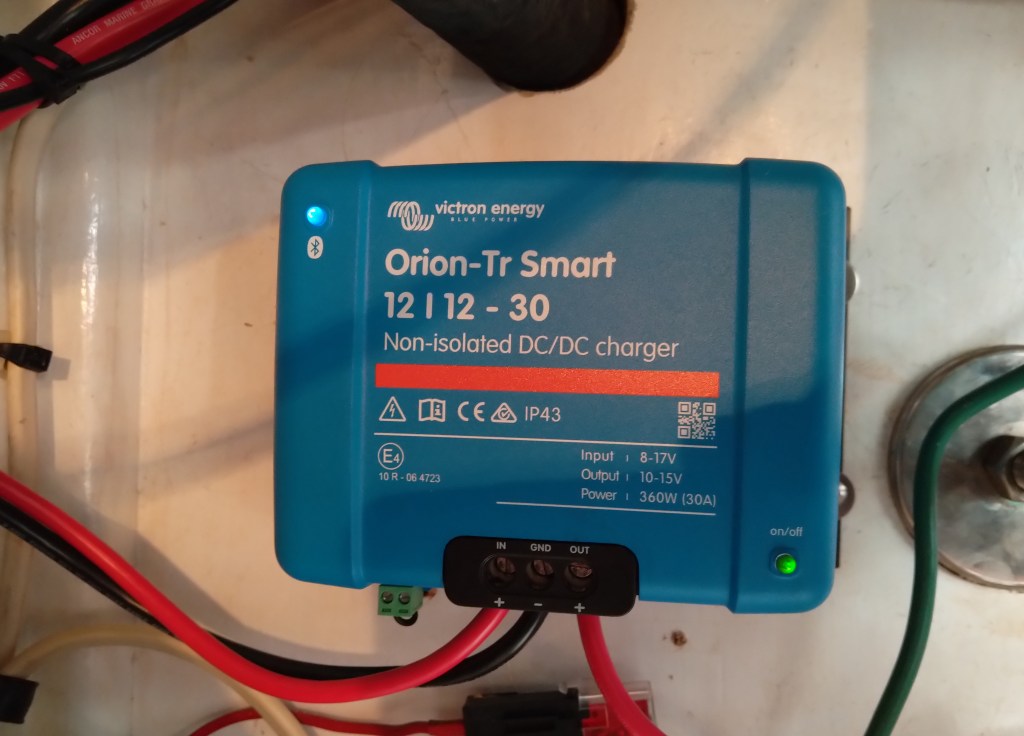
While we generally like Victron’s gear and used it heavily in our solar installation (a topic for a future blog post), Sterling also make reliable DC-DC chargers which I used on our Beneteau. The “Smart” Victron units connect with Victron’s app for easy configuration and monitoring (see image below). While I like this feature, it sadly doesn’t have a way of integrating into Victron’s VenusOS environment leaving you to come up with another way to monitor the battery if you want it part of an integrated dashboard on your plotter or tablet (another topic for a future blog post).
Typically our installation involved finding a spot to put everything and running wires while crammed into a small space, balanced on one hip. I complain, but it wasn’t that bad as we had set up for the project when we did our solar installation and had convenient busbars to tap into. Below is the associated page in the working schematic we maintain for the boat.

 SV Luna Moth
Leave a comment