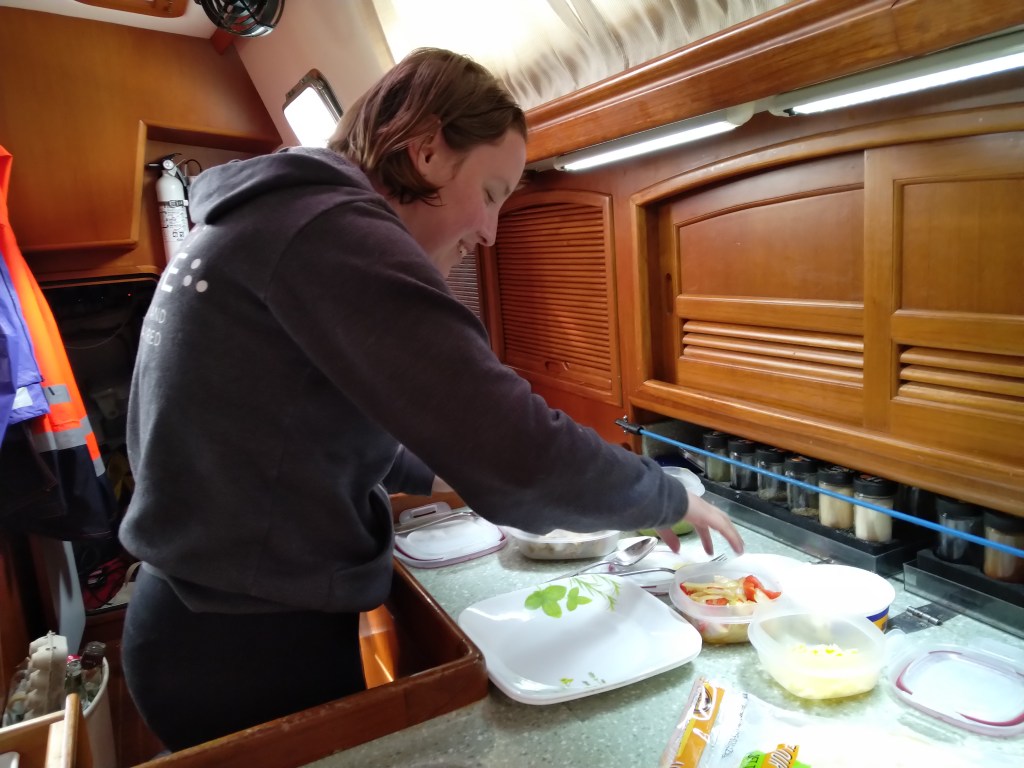
I have always loved food and cooking. However, in my classes on adapted cooking as a blind person they didn’t teach me how to cook on a boat in a tiny galley where your home and your stove could be moving. I have learned a lot about how to live on a boat over the past three years and how to cook on board was and is one of those learning curves that is still evolving. Here are some of my thoughts on cooking in a galley as a blind person.
The first big rule on our boat is that, when possible, we plan to cook meals ahead of passages so when we are at sea we won’t have to cook while there are lots of waves or potentially rough seas. When we are at the dock or at anchor it can still be windy and the boat may still move back and forth a bit. So, cooking with the motion takes a bit of getting used to. We are fortunate that our boat came with many hand-holds built in for walking around the boat when it is moving and for attaching our tethers from our life jackets to that we will wear when sailing. There is also the reality that there is much less storage for all of the kitchen gadgets one would want.
One example of something we had to think of a creative solution for, that is still evolving, is our spice storage. We prefer to use what would be a spice rack in a land-kitchen, but on board is a row of spice jars held in place behind a bungy. We have to think about what material the jars are made of as we don’t want them crashing together when the boat moves in various directions: up and down, left and right and forward and back. We have chosen glass jars that are kept separated by rows of foam. The rows of foam have holes cut in them for the jars to rest. This also spaces them apart and prevents them from sliding around. We have the strips of foam secured inside a plastic picture frame to keep the foam from moving around. We may also in future glue the foam down to the frames. The frames with the foam are on top of our counter underneath our cabinets with a bungy across the opening so the frames don’t slide out.
I also needed to label the jars accessibly and as I didn’t have a great way to make braille labels and am also probably too lazy to make the labels, I have what is called an audio Pen Friend labeler. These are stickers that work with a pen where I record information. This way I tap the pen to the label and it plays the recording I made. This allows me to put quite a lot of information on a label if I want. These can be used for anything I need to label or make note on. The labels can also be reused and the pen takes a standard battery that can be replaced.
Another consideration on the boat is how to boil water for tea and coffee. We do not have a microwave or many electric appliances, so do not have an electric kettle or Hot Shot. This means I have to boil water using a kettle on the stove. As a blind person I can use a liquid indicator which is a little sensor you stick in a cup that beeps when the water reaches it. Unfortunately, the one we had corroded very quickly in the salt water environment. Another method I use is testing the level of water by timing how fast I poor and the weight of the cup. If there is a dark liquid in a lighter cup, I can also see the color contrast. A different method I use is to poor hot water into a large bowl and then scoop out the amount I want with a brailed measuring cup. Now I just have to practice these skills with a boat that sometimes moves back and forth. So, I always work over the sink.
I hope these things that I have shared give you a better idea of how a blind person cooks on a boat. Stay tuned for blind baking…or baking blind.
 SV Luna Moth
Leave a comment